Saturday, October 20, 2012

Abide with Me


Here is another hymn! This one goes out to a good friend of mine, Brianna. I hope you enjoy this and that you will share with others!

Title: Abide with Me

Tune: Eventide

Meter: 10, 10, 10, 10

Composer: William H. Monk (1823-1889)

Author: Henry F. Lyte (1793-1847)

                Born in Ednam, Scotland, near Kelso in 1793 to Captain Thomas Lyte, Henry Lyte was orphaned at a child. Though he was never physically strong, Lyte was a smart scholar, studying at the Royal School of Enniskillen, and eventually at Trinity College in Dublin. During his studies, he earned the esteemed English Prize Poem three times and was thought to have intentions to go off to Medical School to become a doctor. In 1814, when Lyte graduated from Trinity College, he abandoned his ambitions of Medical School and instead studied Theology, taking his first holy orders in 1815 and began his first Curacy in the neighborhood of Wexford in 1817. In 1818, after having removed himself to Marazion in Cornwall, he underwent a great spiritual change that lead to Lyte’s whole view of the afterlife being changed (this can be attributed to the death of his fellow Clergyman). In 1819, Lyte moved to Lymington, where he composed his Tales on the Lord’s Prayer which was written in verse and published in 1826. In 1823, he was appointed the Perpetual Curate of Lower Brixham, Devon, which he held until his death in 1847.
                Though there are two stories about the creation of this hymn, the one that has held the most merit (or has been contested the least), is that Lyte wrote “Abide with Me” towards the end of his life. The text first appeared in a letter written August 25th 1847, in which Lyte called it his “Latest Effusion (Westermeyer, p. 473).” After his last sermon and Eucharist on Sunday September 14th, 1847, given in Lower Brixham, Devon, he resigned from the church because of health problems, and he gave the text to a relative with a tune that he had composed for it. The first time the text appeared was in Lyte’s  Remains  which was published posthumously in 1850. It is generally accepted that the text for “Abide with Me” comes from the bible verse Luke 24: 29, which is the Emmaus story, reading as follows:  “Abide with us; for it is toward evening, and the day is far spent.” Because of this, the hymn is generally mistaken for a hymn that is to be sung at evening, when in reality, the eventide mentioned in the text is a strong metaphor for the ending of the life of a human.
                Just as it was for the hymn, there are two stories about how the tune “Eventide” came to be. The first story is that William H. Monk wrote the tune in ten minutes, after it came to the realization that there was no tune for the hymn, during a committee meeting for the first edition of Hymns Ancient and Modern (1861) where the tune first appeared paired with the text. The second account was given by William Monk’s widow, who claims the tune was written during a great time of sorrow, with her by his side while they watched the sun go down. Wesley Milgate states that the two stories may hold merit by a “committee meeting” at Monk’s home with his co-editor of Hymns Ancient and Modern, Henry W. Baker, who was a frequent visitor to Monk’s home, especially to discuss the project. Though Lyte had written a tune for the piece himself, Monk’s “Eventide” has stayed with the piece throughout its life, marking this one of Monk’s “most characteristic tunes,” (Westermeyer, p. 475). Though Monk was known to have written many tunes throughout his career, his works were known as “to order” for specific texts, and they only served the purpose for the texts and then faded after a short time, being almost” distractingly dull,” (Westermeyer, p. 475).  In most hymnals now, three of the eight verses are omitted, leaving the hymn with five short verses.

The Text:

  1. Abide with me; fast falls the eventide;
    The darkness deepens; Lord, with me abide;
    When other helpers fail and comforts flee,
    Help of the helpless, oh, abide with me.
  2. Swift to its close ebbs out life’s little day;
    Earth’s joys grow dim, its glories pass away;
    Change and decay in all around I see—
    O Thou who changest not, abide with me.
  3. I need Thy presence every passing hour;
    What but Thy grace can foil the tempter’s pow’r?
    Who, like Thyself, my guide and stay can be?
    Through cloud and sunshine, Lord, abide with me.
  4. I fear no foe, with Thee at hand to bless;
    Ills have no weight, and tears no bitterness;
    Where is death’s sting? Where, grave, thy victory?
    I triumph still, if Thou abide with me.
  5. Hold Thou Thy cross before my closing eyes;
    Shine through the gloom and point me to the skies;
    Heav’n’s morning breaks, and earth’s vain shadows flee;
    In life, in death, O Lord, abide with me.

My Take on the Hymn:

                This hymn is one of honor and praise to Christ. The text often asks the question, who else can help me through my times of trials? God has a great love for all of us, and sometimes he asks us to turn to Him through our troubles. This hymn reminds us that we have no power of the grip of temptation if we don’t have the grace of God. God’s grace is the greatest gift we can see every day, and it was by his grace that we were given Jesus on the Cross. In stanza four, I feel that the voice of the text becomes almost challenging and boisterous. With God on our side, we needn't have any fear or anxieties, because through Christ, everything will be taken care of, and nothing, not even death, will have power over us!

The Hymn:


Bibliography:
Julian, John. "Henry Francis Lyte." - Hymnary.org. Calvin Institute of Christian Worship, n.d. Web. 20 Oct. 2012. <http://www.hymnary.org/person/Lyte_HF>.
Westermeyer, Paul. "Abide with Me, #629." Hymnal Companion to Evangelical Lutheran Worship. Vol. 1. Minneapolis, MN: Augsburg Fortress, 2010. 473-75. Print.
"Abide with Me, #629." Evangelical Lutheran Worship. Vol. 1. Minneapolis, MN: Augsburg Fortress, 2006. 629. Print.

Monday, October 15, 2012

Come to Me, All Pilgrims Thirsty


Here comes another Hymn, this one comes with a tie to St. Cloud Minnesota, a place in which I enjoy visiting on occasion (the Benton County Fair being one of them!)!

Title: Come to Me, All Pilgrims Thirsty

Tune: Beach Spring

Meter: 8.7.8.7.8.7.8.7

Composer: Benjamin Franklin White (September 20th, 1800-December 5th, 1879)

Author: Delores Dufner (B. 1939)

                Sister Delores Dufner, a member of the Benedictine Sisters, is one of the best known hymn composers in the world today. She has had hymns published in over twenty different hymnals, including hymnals printed in Australia, Canada, and England. She first performed this hymn in 1982, paired with a tune composed by Jay F. Hunstiger, in St. Mary’s Cathedral in St. Cloud Minnesota. The hymn was performed as a communion song at the annual Chrism Mass, when the Bishop with bless the oils used in the sacraments such as Baptism, Confirmation, Ordination, and in the anointing of the sick. The hymn was first published with Hunstiger’s tune in the 1989 publication of The Order of Christian Funerals: Funeral Mass (Collegeville). “Come to Me, All Pilgrims Thirsty,” also appeared in the 1997 Schiller Park hymnal We Celebrate, where the revised version of the first three stanza’s were paired with the tune “Holy Manna (see hymns “God Who Stretched the Spangled Heavens,” and “All Who Hunger, Gather Gladly.”)” which is also seen in People’s Mass Book (Schiller Park, 2003). The Hymn has been seen in England under the title “Jesus, Ever-Flowing Fountain,” With a setting by Australian composer, Rosalie Bonighton, which was published in several different hymnals, including the Chinese Christian Literature Council Bilingual Hymns of Universal Praise (2006).
                One advantage of researching a hymn composed by someone who is still living is that we get to hear the reasons the composer has for writing the hymn.
“This text was inspired primarily by the lengthy dialogue between Jesus and the Samaritan woman at the well (John 4). I have always loved this account of the assertive woman who dared to challenge Jesus. When she questioned him about his request for a drink, he responded ‘If you only knew what God is offering…’ Jesus’ words to her might well be addressed to each of us: if we really understood the good that God wants to do for us, we would come to Christ gladly and freely to find life, refreshment, and forgiveness. These gifts are offered in a special way at the Eucharistic table.
I drew on two other scripture texts for this hymn. The first is John 7:37-39, in which Jesus cries out, ‘let anyone who is thirsty come to me and let the one who believes in me drink.’ The second is Matthew 11:28-30, in which Jesus invites the weary and heavily burdened to come to him for rest, ‘for my yoke is easy, and my burden is light.’
Because the words of the stanzas are Jesus’ and the words of the refrain are our response, I suggest that they be sung by different groups, e.g., stanzas by choir and refrain by congregation, or stanzas by women and refrain by men.” (Westermeyer, p 644), (See bibliography #1).
                The tune “Beach Spring” is attributed to Benjamin Franklin White, who with the help of Elisha J. King, published The Sacred Harp (Philadelphia, 1844), where it was sung with the text of “Come, ye sinners, poor and wretched.” Named after the Beach Spring Baptist Church in Harris County, Georgia, the church was given its name because of its close proximity to “two beech trees at a spring…(Westermeyer, p. 269).” Although the original spelling of the name should be “Beech,” White’s misspelling “Beach,” has stuck with the hymn throughout the ages. White was mostly a self-taught singing school teacher from South Carolina. Eventually he moved to Hamilton in Harris County, Georgia, where he worked at many different vocations, including a stint in the Georgia Militia. Eventually White married Thurza Golightly, and together the two had 14 children (the same number of children that White’s parents had).  At some point along the timeline of Benjamin Franklin White’s history, a rumor was started that he worked closely with William Walker (who was his brother-in-law) to publish Southern Harmonies, but this rumor was probably not true.  The two books were wildly popular in the south, but both contained the same southern white spirituals which were popular in the more rural areas. In the 20th century, the tunes from The Sacred Harp, and Southern Harmonies entered into more denominational hymnals and inspired many different composers to arrange the melodies in various ways. The Sacred Harp is one of the most used books in the four-shape notation, and has gone through numerous editions that have been published throughout the years, and even to the present days.

The Text:

V1. “Come to me, all pilgrims thirsty;
Drink the water I will give.
If you knew what gift I offer,
You would come to me and live.”
Refrain. Jesus, Ever flowing fountain,
Give us water from your well.
In the gracious gift you offer
There is joy no tongue can tell.
V2.  “Come to me, all trav’lers weary;
Come that I may give you rest.
Drink the cup of life I offer;
At this table be my guest.”
Refrain.
V3.  “Come to me, believers burdened;
Find refreshment in this place.
Come, receive the gift I offer,
Turn to me and seek my face.”
Refrain.
V4. “Come to me, repentant sinners;
Leave behind your guilt and shame.
Come and know divine compassion,
Turn to me, I call your name.”
Refrain.

My Take on the Hymn:
                This hymn is a wonderful reminder that Christ does not care what you have done in the past, but rather what you will do from this point forward. Jesus says to us in John 4, “If you only knew what God is offering…” which speaks volumes to the world today. If people only knew the love that Christ has for us, and the love that is waiting for us, the ecstatic crowds of people running to Christ would be incredible.  Christ is calling us, and he is calling us today. In stanza 1, Christ invites us all to the fountain of life, and he also tells us that if we but only open our eyes to the gift that he is giving us, we will turn and run to him. Stanza 2 really references Matthew 11: 28-30, by telling us that if we are weary, we should come to Christ and leave all of our struggles with Him. Being a college student- with all of the stress that accompanies mid-terms, juries, friends, time management, as well as everything else that goes on in life- Christ wants to take it for us, he is there to give us a break. Stanza 3 reminds us that it isn’t easy being a follower if Christ. As followers of Christ, we find ourselves going against the grain of society, and doing what we think is right, not always what is popular, and there lies the challenge. Whatever those challenges may be, God is there to help you through them and to refresh you every time you partake in the receiving of communion (or the Eucharist for those who are Catholic). Stanza 4 is my favorite, this is the verse that tells us to turn away from ourselves and turn to Christ. We have all sinned, and we all have shame to bare, but through Christ, our sins are forgiven, and we no longer need to carry the burden of shame! Christ calls us to be with Him, because he loves us no matter the life we have lived up to the day we turn to Him. There is no better time than right now to turn away from the life you are leading now, and to follow Christ!

The Hymn:
Unfortunately I was not able to find music for this hymn. At a later point I will have an update with the music, as soon as I can get over to the Library to use the scanner! But, in the meantime, here is the youtube video.


Bibliography:
Westermeyer, Paul. "Hymn No. 777." Hymnal Companion to Evangelical Lutheran Worship. Minneapolis, MN: Augsburg Fortress, 2010. 269+. Print.


Sunday, October 7, 2012

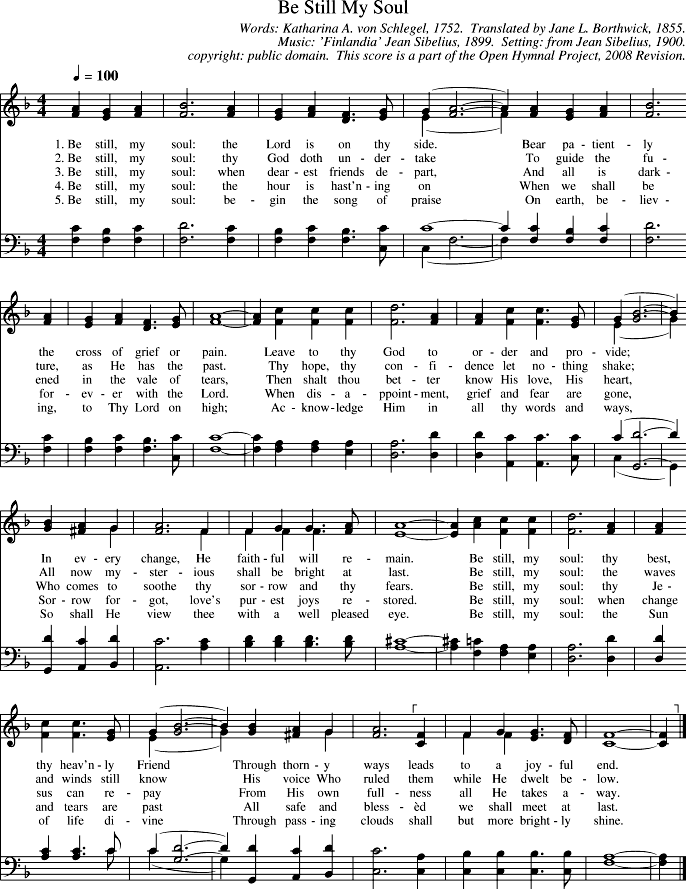
Be Still, My Soul


Here is another hymn! This one goes out to a good friend, and a very talented woman (who also happens to have a birthday today), Morgan. I hope you enjoy and have a good Birthday!

Title: Be Still, My Soul

Tune: Finlandia

Meter:  10.10.10.10.10.10

Composer: Jean Sibelius (1865-1957)

Author: Kathrina Von Schlegel (1697-c. 1797), Translated by: Jane Borthwick (1813-1897)

                Though this hymn is very popular and famous, there is very little known about Katherin Von Schlegel, other than she didn’t write many hymns, and the only one to have been translated from German to English, was in fact, “Be Still, My Soul.” Born in 1697, Von Schlegel was known to be the "Stiftsfräulein" in the Evangelical Lutheran Stift (similar to a protestant nunnery) at Cothen. All though she was involved with the courts in Cothen, her name did not appear in the records, but by word of mouth it is known that she was involved there. “Stille, meine wille, dein Jesus Hilft siegen” appeared in 1752 and contained six stanza’s with six lines each, and later it was published again in 1837 in Knapp’s Evangelischer Lieder-Schatz. The translation, written by Jane Borthwick, maintained much of the original text (but Borthwick omitted the third stanza), and was published in Borthwick’s 1855 Hymns from the Land of Luther, 2nd series (there were four editions, 1st series, 1854; 2nd, 1855; 3rd 1858; 4th, 1862). More is known about Jane Borthwick than of Kathrina Von Schlegel.  Jane Borthwick was born in Edinburgh, Scotland, to James Borthwick, who was the manager of the North British Insurance Office in Edinburgh. She began translating many of the hymns from German in to her hymnal in 1854, but was also known for having written some prose of her own. She published most of her works in the 1857 collection Thoughts for Thoughtful hours.  In 1875 she published a selection of poems translated from Meta Heusser-Schweizer, under the title of Alpine Lyrics, which were included in the 1884 edition of the Hymns from the Land of Luther.
                The tune, “Finlandia” was originally composed by Finnish composer, Jean Sibelius, as part of a larger work aimed at supporting the Finnish press against Russian oppression in 1899. Originally composed as one of Six Tableaux in a work for the pageant, Sibelius took the last Tableau and rewrote it as an orchestral tone poem, naming it “Finlandia.” The Chorale-like opening to the tone poem is most commonly used for the hymnal. The tune was first used in the Scottish Hymnal in 1927, and was used later in the Presbyterian Hymnal in 1933. Though the melody is simple, it is difficult for most congregations to maintain a steady tempo with all the stops and rests in the melody, which requires great leadership from the organist.  Sibelius began his musical career by studying piano and violin, and at one point in his life, he considered becoming a Concert Violinist. Although Sibelius may have been successful as a Violinist, he began his compositional career at the age of ten. Much like Beethoven, Sibelius used each of his seven symphonies to build his musical styling’s. In 1897, Sibelius received a pension for life from the Finnish Government, allowing him to travel all around Europe from 1900 until the beginning of World War I. He was famous for conducting his own pieces, and was well received when he came to visit the United States of America in 1914. Though Sibelius did not compose any works in the final 26 years of his life, he did maintain a well-founded reputation from  the works he had done earlier in his career.

The Text:

1. Be still, my soul; the Lord is on thy side;
Bear patiently the cross of grief or pain;
Leave to thy God to order and provide;
In every change He faithful will remain.
Be still, my soul; thy best, thy heavenly, Friend
Through thorny ways leads to a joyful end.

2. Be still, my soul; thy God doth undertake
To guide the future as He has the past.
Thy hope, thy confidence, let nothing shake;
All now mysterious shall be bright at last.
Be still, my soul; the waves and winds still know
His voice who ruled them while He dwelt below.

3. Be still, my soul, though dearest friends depart
And all is darkened in the vale of tears;
Then shalt thou better know His love, His heart,
Who comes to soothe thy sorrows and thy fears.
Be still, my soul; thy Jesus can repay
From His own fulness all He takes away.

4. Be still, my soul; the hour is hastening on
When we shall be forever with the Lord,
When disappointment, grief, and fear are gone,
Sorrow forgot, love's purest joys restored.
Be still, my soul; when change and tears are past,
All safe and blessed we shall meet at last.

My Take on the Hymn:
               
This is one of my favorite tunes to sing in church, especially because both my Father and I enjoy Jean Sibelius (at one point in my musical career, I won a piano competition by performing Sibelius’ Romance in Db) and we can always have a good laugh because we both know Sibelius well. This hymn is very powerful in the words it uses to tell us to sit back and relax, everything will be okay because God has your best interests in mind. God has a plan for us, and sometimes that is very difficult to see and to accept, but we as Christians should attempt to gain peace of mind through scripture, and time of prayer with Christ. In Matthew 6: 25-34, Jesus tells us not neither to worry about the days ahead nor to worry about the little things in life, God has us taken care of. To paraphrase some of what C.S. Lewis says in his book,  A Grief Observed, if we stop focusing on God and instead focus on the pain and the sorrows of everyday life, we will struggle every day to see the happiness that is promised to us all. If God maintains his position of the focus for our lives, everything else will fall in to place, leaving our souls at peace!

The Hymn:

If you cannot read music, just start the youtube video and follow along!

and just because this one is one of my favorite versions:


Bibliography:
Julian, John, and Psalter Hymnal Handbook. "Be Still, My Soul." Hymnary.org. Calvin Institute of Christian Worship, n.d. Web. 07 Oct. 2012. <http://www.hymnary.org/text/be_still_my_soul_the_lord_is_on_thy_side>.


Monday, October 1, 2012

O Sacred Head, Now Wounded


Here is another post, sorry for the delay, but school work is just as important. This is my first hymn with my new book, the Hymnal Companion for the Evangelical Lutheran Worship Hymnal. 

Title: O Sacred Head, Now Wounded

Tune: Herzlich Tut Mich Verlangen

Meter: 76.76. D

Composer: 16th century German Melody, Adapt. Hans Leo Hassler (1564-1612), Arr. Johann Sebastian Bach (1685-1750)

Author: Paul Gerhardt (1607-1676), Based on Arnulf of Louvain, d. 1250 (attributed to Bernard of Clairvaux, 1090-1153)


                Paul Gerhardt was born in Grayfenhaynischen, Germany in 1607, which is a small town just outside of Wittenberg. When he was 21 years old, Gerhardt began school at the University of Wittenberg, where he stayed until he was 35 years old. It was the year 1642 and Gerhardt was said to have left Wittenberg to go to Berlin to be a tutor for a number of years in the house of the Advocate Andreas Barthold, where he met his wife Anna Maria (they married in 1655), who was the daughter of Barthold. During his time in Berlin, he began to preach around the area and eventually, he accepted a call in 1651 to be the Lutheran Probst (head Pastor) and Mittenwalde, near Berlin, which was received after a glowing recommendation was given by the Berlin Clergy. Gerhardt remained at his post in Mittenwalde until 1657, when he returned to Berlin to work as the third Diaconus of St. Nicholas’s Church in Berlin. After changing his position in the church, Gerhardt ran in to political trouble with the Elector Friedrich Wilhelm (who was a member of the reformed church), and the Berlin Clergy. This political unrest would cause Gerhardt to be deposed of his position in the church in 1666, but he would return to work in the church once again as the Archdiaconus of Lubben in 1669 and remained there for the rest of his life. Though Gerhardt’s life was not a stable one, with the loss of four children (only one of his five survived past infancy), the death of his wife during the few years he was unemployed in Berlin, and a calling in Lubben that was less than supportive of his preaching, he was still known as one of the greatest Lutheran hymn writers next to Luther himself.
                The hymn “O Sacred Head, Now Wounded,” is a lesson in translations by itself. The history of this hymn begins back in the late 16th century when the traditional language was Latin. Eventually, however, thanks to the work of one Martin Luther, the Catholic Church was reformed and no longer had control over the mass (which was traditionally done in Latin, so no one, besides those who were educated, could understand the mass), and the German language became more commonly used in the mass settings, but, was also being used in a new form of worship which would later be called “Lutheran.” Later, as the Lutheran Church grew more and more popular, the language had to be changed once again, this time from German to English. The original text to this hymn can be found in the Opera Omnia, attributed to Bernard of Clairvaux, though it is attributed to him with an asterisk of sorts. The Opera Omnia is often times attributed to another man as well, Arnulf of Louvain, but it has never been proven with complete certainty who wrote the text. Though the text does not have a known “author” to speak of, but it has been read and translated by several people. The text for this hymn is a small part of a larger work that would later come to be part of Johann Sebastian Bach’s St. Matthew Passion.
 “Salve, mundi salutare” was originally called Rhythmica Oratio ad Unum Quodlibet Membrorum Christi Patientis et a Cruce Pendentis which loosely translates to “Rhythmic Prayer to the Various Members of Christ’s Body Suffering and Hanging on the Cross.” This text had seven sections for each day of the week before Easter Sunday, or more commonly known as Holy Week. Each section was supposed to represent a different part of Christ’s body and was written in the following order: feet, knees, hands, side, breast, heart, and Face. Each section was a stanza containing ten five-line stanzas of eight syllables each (Westermeyer, 155), with the exception of the last stanza, which contained fourteen five-line stanzas of eight syllables (Westermeyer, 155). Finally, we come to the point at which Paul Gerhardt comes into contact with the text to translate. The Work was set to music in the form of seven cantatas called Membra Jesu Nostri, which was written by Dietrich Buxtehude (1637-1707), who came in contact with a young J.S. Bach. The last cantata, or “Salve caput cruentatum,” in Latin, “O Haupt voll Blut und Wunden,” in German and “O Sacred Head,” contains ten stanzas and is considered to be the most well-known of all the cantatas. The final stanza was published in the 1656 collection Praxis Pietatis Melica, by Johann Cruger, and was translated to English and published by James Waddell Alexander (1804-1859) in The Christian Lyre (Published in New York, 1831). The Translation used in the Evangelical Lutheran Worship uses a translation relying heavily on the version translated by Waddell.
The tune “Herzlich Tut Mich Verlangen” was originally paired with this text in 1656 when it was published in Praxis Pietatis Melica, which gave it a second name, Passion Chorale, though it was not paired with a sacred text until it was published with the funeral text of Cristoph Knoll in 1613 after the death of the composer. The tune was composed originally as a court song, written by the Renaissance composer, Hans Leo Hassler, and was published in his collection Lustgarten Neuer teutscher Gesang (published in 1601). The tune was also used along with a serious text based on the penitential psalm, Psalm 6, published in 1625 (Ach, Herr, mich armen Sunder,).  Hassler was well known for composing several different collections of German Motets (1591 and 1601), as well as chorale motets, Psalmen und christliche Gesänge (1607), and a collection of simpler hymn settings, Kirchengesänge, Psalmen und geistliche Lieder (1608).Hassler was known for being a Lutheran composer, but was known to have written several hymns for the Roman Catholic Church.
Hassler took a step towards bridging the gap between “Sacred,” and “Serious Secular,” music.  The original tune had a five part setting as a love song to “Maria”- “Mein G’must ist mir verwirret, das macht ein Jungrau zart” (“My heart is all excited, a sweet young maid is near”)-whose name was spelled out in an acrostic by the first letter of each stanza of the text (Westermeyer, p 157). Though this hymn is usually sang as a congregational hymn, it was composed in two different manners, one in a rhythmic pattern, and one with an isometric pattern. Though the rhythmic version is most commonly used version and was composed first. The isometric versions of chorales usually lack rhythmic interest, but contain many different examples of harmonic interest. One such occurrence of the isometric version is founded from a section of J.S. Bach’s St. Matthew Passion, which turns the hymn into a chorale type as opposed to a congregational hymn.  Another very uncommon use of the tune came from Paul Simon, who used it for his “American Tune,” after Art Garfunkel introduced it to him through one of Bach’s harmonizations.


The Text:
1.            O sacred Head, now wounded,
                with grief and shame weighed down,
                now scornfully surrounded
                with thorns, thine only crown:
                how pale thou art with anguish,
                with sore abuse and scorn!
                How does that visage languish
                which once was bright as morn!

2.            What thou, my Lord, has suffered
                was all for sinners' gain;
                mine, mine was the transgression,
                but thine the deadly pain.
                Lo, here I fall, my Savior!
                'Tis I deserve thy place;
                look on me with thy favor,
                vouchsafe to me thy grace.

3.            What language shall I borrow
                to thank thee, dearest friend,
                for this thy dying sorrow,
                thy pity without end?
                O make me thine forever;
                and should I fainting be,
                Lord, let me never, never
                outlive my love for thee.


My Take on the Hymn:
                This hymn is a very stark reminder of what Christ sacrificed for us, so that we may live a life free of sin and free of the grasp the death maintains on those who fear the grave. The hymn does not use any allusions, but is rather strait forward in saying that Christ was shamed by us and was punished for and by our sins. Christ’s love for us is incredible, not only because he bore the cross for us, but because even in the darkest moment of his life, the moment when we shouted for Christ to be crucified, he thought of us and asked God to forgive is, for we did not know what we were doing. God’s love is never failing, and the fact the He sent his only son to the cross so that we may live free only augments the reality of His love for us.


The Hymn:
If you can't read music, just click on the youtube link and follow along!


 Bibliography:


"O Sacred Head Now Wounded." Hymnary.org. Calvin Institute of Christian Worship, n.d. Web. 02 Oct. 2012. <http://www.hymnary.org/text/o_sacred_head_now_wounded>.

Westermeyer, Paul. "Holy Week." Evangelical Lutheran Worship Hymnal Companion. Ed. Paul Westermeyer. Vol. 1. Minneapolis, Minnesota: Augsburg Fortress, 2010. 155-57. Print.

"Holy Week." Evangelical Lutheran Worship. Minneapolis, Minnesota: Augsburg Fortress, 2006. 351. Print.

Sunday, September 23, 2012

For the Beauty of the Earth

This is one of my favorite hymns, especially as we come in to the wonderful season of Autumn!

Title: For the Beauty of the Earth

Tune: Dix

Meter: 7.7.7.7.7.7.

Composer: Conrad Kocher (1786-1872)

Author: Folliott S. Pierpoint (1835-1917)

     As we walk out into the world during the season of fall, we are filled with sensations that can only be described as overwhelmingly beautiful. We come out into a world full of color, full of fresh, cool, crisp, air with the smell of the harvest season lingering on our noses. The world seems a more beautiful place, even though the season of relaxation (i.e. Summer) has come to an end. As Autumn approaches, we see the different birds flying south for the winter, the fields turn from the green growth, into waves of amber color that seem to stretch on for miles in the country. It was these things that inspired the author, Folliot S. Pierpoint, to compose the text for this wonderful hymn. Born in 1835 in Bath, England, Pierpoint was an educated man, studying at Queens College in Cambridge, and graduating with a degree in Classical Honours. after he graduated, Pierpoint went out for a walk around his hometown. While out on his walk, he was so inspired by the beauty of the nature that he sat down and penned the words.
     The words to "For the Beauty of the Earth" were published when Pierpoint was at the young age of 29. He published the text in Rev. Orvy Shipley's Lyra Eucharistica in 1864, because the hymn was originally meant to be a Eucharistic Hymn for the Anglican Church (of which Pierpoint was a member of). The Chorus that was originally penned was originally read "Christ our God, to the we raise this our sacrifice of praise," but was later changed to "Lord of all, to thee we raise, this our grateful hymn of praise," in order that the hymn could be used for more than just the Eucharist. The original text had eight verses that were published, but in the most recent publications of Hymns Ancient and Modern, as well as the Presbyterian Church Hymnary, the final three verses have been removed for being "too Catholic in wording." While these churches have omitted the last three verses, they have, however, published the hymn with the original line of the chorus ("....this our sacrifice of praise.").
     The tune "Dix," was written by a man named Conrad Kocher, who was originally born in Ditzingen, Wurttemberg, Germany, where he was trained as a teacher. At the age of 17, Kocher left Germany to work as a tutor in St. Petersburg, Russia (this would have been c. 1803). Eventually, Kocher's love for composers such as Mozart and Haydn influenced him to pursue a career in music. in 1811, he moved back to Germany and settled into the town of Suttgart, Germany, where he would remain for most of his life. During the early years of his music career, the prestigious Cotta Music Firm published some of his works, and eventually sent him to study music in Italy for a period. After kocher completed his studies in Italy, he returned to Suttgart where he founded the School for Sacred Song, which encouraged the use of four part singing in the church. In his career, Kocher published two Operas, an Oratorio, and a few Sonatas. The most well known version of "Dix" came from a shortening of Kochers Treuer Heiland, wir sind hir,” found in Kocher's Stimmen aus den Reiche Gottes, (published in 1838). The final arrangement was done by William H. Monk and was published in the 1861 version of Hymns Ancient and Modern, of which Monk was the music editor for. Though Monk regretted using this tune as a pair for the text, it has proven to be a good match over the last several years. 

     This hymn is one of great praise and thanksgiving. The text talks about all the wonderful things that we have been given on this Earth, and that we should raise them up to God and be thankful for them. As we come into the season of Autumn, the wonderful beauty that envelopes us as we go out into the world is a gift from God that we should be ever thankful for. Pierpoint does however go beyond the simple aesthetics of the world, but of the beauty of friendship found in one another. There is beauty in the world all around us, and even if we cannot see it, beauty still remains in the intangible. 

The Text: 


(1) For the beauty of the earth,
For the glory of the skies;
For the love which from our birth,
Over and around us lies;
Lord of all, to Thee we raise
This, our hymn of grateful praise.

(2) For the wonder of each hour,
Of the day and of the night;
Hill and vale and tree and flow'r,
Sun and moon, and stars of light;
Lord of all, to Thee we raise
This, our hymn of grateful praise.

(3) For the joy of ear and eye,
For the heart and mind's delight;
For the mystic harmony,
Linking sense to sound and sight;
Lord of all, to Thee we raise
This, our hymn of grateful praise.

(4) For the joy of human love,
Brother, sister, parent, child;
Friends on Earth and friends above,
For all gentle thoughts and mild;
Lord of all, to Thee we raise
This, our hymn of grateful praise.

(5) For Thy church that evermore,
Lifteth holy hands above;
Off'ring up on ev'ry shore,
Her pure sacrifice of love;
Lord of all, to Thee we raise
This, our hymn of grateful praise.

My Take on the Hymn:

      This hymn is one of great praise and thanksgiving. The text talks about all the wonderful things that we have been given on this Earth, and that we should raise them up to God and be thankful for them. As we come into the season of Autumn, the wonderful beauty that envelopes us as we go out into the world is a gift from God that we should be ever thankful for. Pierpoint does however go beyond the simple aesthetics of the world, but of the beauty of friendship found in one another. There is beauty in the world all around us, and even if we cannot see it, beauty still remains in the intangible. 

The Hymn:


If you cannot read music, just play the youtube video and follow along. 

Bibliography:

Guidebook, Psalter Hymnal. "DIX (Kocher)." Hymnary.org. Calvin Institute of Christian Worship, n.d. Web. 23 Sept. 2012. <http://www.hymnary.org/tune/dix_kocher>.

Guidebook, Psalter Hymnal. "DIX (Kocher)." Hymnary.org. Calvin Institute of Christian Worship, n.d. Web. 23 Sept. 2012. <http://www.hymnary.org/tune/dix_kocher>.

"For the Beauty of the Earth." Hymnary.org. Calvin Institute of Christian Worship, n.d. Web. 23 Sept. 2012. <http://www.hymnary.org/text/for_the_beauty_of_the_earth>.


Monday, September 17, 2012

I Know That My Redeemer Lives

Here is another Hymn. This one goes out again to Father Tim Biren, thank you so much for your donation of books to my study of hymns! This one comes from the third edition of Worship, A Hymnal and Service Book for Roman Catholics.

Title: I Know That My Redeemer Lives

Tune: Duke Street

Meter: 8.8.8.8. (Long Meter)

Composer: John Hatton, (c. 1710-1793)

Author: Samuel Medley, (1738-1799)


                Often times, some of the best known works in the religious world come from people that did not begin their life in a religious way. Samuel Medley was a prime example of this, much like fellow poet John Newton. Born June 23rd 1738 in Chestnut, England, Medley was the son of a School teacher, but none-less, he was educated privately by his grandfather. While studying with his grandfather, Medley was taught to live faithfully by Christian values, but he was not interested in following what was being taught. As he grew up, Medley became friends with boys who were not Godly, and lead sinful lives. Eventually at the age of 14 (c. 1752), Medley was given an apprenticeship with an oil-man in London, but he only lasted 3 years in with the oil-man before he began searching for a way out. After finding a loop-hole in the law, Medley discovered that a person can leave an apprenticeship and join the military service, which lead him to join the British Royal Navy. While in the Navy, Medley’s life style did not improve, but rather became even more crass and profane than before.
 In 1759, during the Seven Year’s War, Medley’s ship engaged in a naval battle with a French ship, during which Medley’s leg was severely injured. After the battle was over, Medley’s leg continued to grow worse, even to the point of potentially having to amputate the leg to save Medley’s life. One evening, the physician aboard the ship told Medley that if his leg did not improve by morning, they would have to amputate or he could face death. During the night, Medley turned back and remembered what his grandfather had taught him when he was younger, and he began to pray vigorously that his leg may be spared. The next morning, to the surprise of all on the ship, the physician examined the leg and determined that it had healed so well that amputation was no longer needed. Immediately afterwards, Medley returned to his room, found the bible his grandfather had given him, and began reading. When Medley’s ship had finally returned to England, he was sent to his grandfather’s house where he was allowed to recover. Eventually, during his recovery, Medley’s grandfather read a sermon written by Isaac Watts, which moved Medley so greatly; he immediately converted and became a Christian. After his conversion, Medley began attending the Baptist Church in Eagle Street, London. Shortly after, Medley opened a school, which he ran with great success for nearly six years, but then he found a new calling.
In 1767, Medley began preaching, and eventually he became so popular in his teachings that he was called to be Pastor at the Baptist Church in Watford, England. After five short years in Watford, Medley moved on to Byrom Street, Liverpool, where he gathered a large congregation of a 27 year period. Medley took a special interest in the souls of Seamen and Servicemen, and was so wildly popular that soon his meeting place could not sustain the number of people coming to hear him preach. After a short time, the meeting space was enlarged, but this would prove useless as the number of people coming to hear the sermons was still growing. Eventually the crowds grew so great that an entirely new building had to be constructed to allow room for everyone who wanted to hear the words of Medley. Although his career was successful, Medley fell ill and maintained his illness for quite some time. After his long fight, Medley finally passed away July 17th 1799, but many of his hymns maintain their popularity in the Baptist Church, one of the most famous of which is “I Know That My Redeemer Lives.”
The first publication of “I Know that My Redeemer Lives,” appeared in Emma Smith’s hymnal published in 1835 with only seven short verses. Eventually the text was compressed into four longer verses, but in order to make the text fit the new musical form, the last line of the verse had to be repeated (found on some occasions). The first appearance of the tune “Duke Street,” came anonymously in Henry Boyd’s 1793 publication of Select Collection of Psalm and Hymn Tunes. Eventually the tune was credited to one John Hatton, of which virtually nothing is known, other than he lived on Duke Street in St. Helen, Lancaster, England. The tune is only one of many different potential tunes that can be used with this given text, but this tune is generally found to be used in the Catholic Church.
The Text:
I know that my Redeemer lives;
What comfort this sweet sentence gives!
He lives, He lives, who once was dead;
He lives, my ever living Head.

He lives to bless me with His love,
He lives to plead for me above.
He lives my hungry soul to feed,
He lives to help in time of need.

He lives triumphant from the grave,
He lives eternally to save,
He lives all glorious in the sky,
He lives exalted there on high.

He lives to grant me rich supply,
He lives to guide me with His eye,
He lives to comfort me when faint,
He lives to hear my soul’s complaint.

He lives to silence all my fears,
He lives to wipe away my tears
He lives to calm my troubled heart,
He lives all blessings to impart.

He lives, my kind, wise, heavenly Friend,
He lives and loves me to the end;
He lives, and while He lives, I’ll sing;
He lives, my Prophet, Priest, and King.

He lives and grants me daily breath;
He lives, and I shall conquer death:
He lives my mansion to prepare;
He lives to bring me safely there.

He lives, all glory to His Name!
He lives, my Jesus, still the same.
Oh, the sweet joy this sentence gives,
I know that my Redeemer lives!
My Take on the Hymn:
                This hymn is one of great praise, especially coming from someone who did not know God’s love until later in life. The story of Samuel Medley serves to show that God does not leave us alone, even when we constantly tell ourselves that we do not want, nor do we believe in, God’s love. This hymn reminds us that God does live every day in us, and that he lives for us, not just so that we may sing his praise, but that we may be saved in Him. Just the other day while in church, I thought to myself, why does God get to use us, and furthermore, why does He want to use us? There isn’t really any other answer to this question other than His love for us is so strong that he wants us to be with him eternally, and the only way to do that is to live in his way. Living like Christ and like God is not an easy task, and is something that we as humans cannot do simply on our own. It takes God and His power to allow us to live a life worthy of Him.
The Hymn:

If you can't read the music, just follow along with the Youtube video.

Here is the Youtube Video:


Bibliography:

Julian, John. "Samuel Medley." - Hymnary.org. Calvin Institute of Christian Worship, n.d. Web. 17 Sept. 2012. <http://www.hymnary.org/person/Medley_S>.

Graves, Dan. "Church History and Christian Timeline." Christianity.com. Christianity.com, May 2007. Web. 17 Sept. 2012. <http://www.christianity.com/ChurchHistory/11630229/>.

Chicago, Archdiocese Of. "Hymn No 445." Worship: A Hymnal and Servic Book for Roman Catholics. Third ed. Vol. Vol 1. Chicago, IL: GIA Publications, 2001. N. 


Tuesday, September 11, 2012

Blessed Assurance: Jesus is Mine

Sorry for the delay, but here is another one for the books!

Title: Blessed Assurance: Jesus is Mine

Tune: Assurance

Numeric Outline: 9.10.9.9. with refrain

Composer: Phoebe Palmer Knapp (1839-1908)

Author: Fanny J. Crosby (1820-1915)

     Many authors who are known for hymns have been ordained ministers before they started writing verse, but Fanny J. Crosby, however, was not. Although she was not ordained, she held a very prominent role in the history of the United States, Crosby was the first woman to be heard in front of the United States Senate. Born Southeast County, Putnam, New York, March 24th 1820, she became blind at only six weeks of age. She became blind because she did not receive proper treatment while she had a bout of illness. As Crosby grew older, she moved to the city of Eidgefield, Connecticut and lived there for four years, when she eventually returned to New York. At the age of 15, Crosby began her studies as the New York institution for the Blind, and later in 1847 she became a teacher there as well. During her time at the institution, Crosby spent the school vacations away in North Reading, Massachusetts, where she wrote numerous poems for Dr. Geo F. Root, professor of music at the blind institution.
     Through her years at the blind institution, Crosby came across many prominent political figures, and among them was one Henry Clay. When Crosby met with Henry Clay, she had already wrote him several poems, one of which was written to honor Clay's son who had been killed in the Civil War. Crosby says of her meeting with Clay  " When Mr. Clay came to the institution during his last visit to New York, I was selected to welcome him with a poem. Six months before he had lost a son at the battle of Monterey, and I had sent him some verses. In my address I carefully avoided any allusion to them, in order not to wound him. When I had finished he drew my arm in his, and, addressing the audience, said through his tears: ' This is not the first poem for which I am indebted to this lady. Six months ago she sent me some lines on the death of my dear son.' Both of us were overcome for a few moments. Soon, by a splendid effort, Mr. Clay recovered himself, but I could not control my tears." Over the 95 ninety-five years of Crosby's life, she penned nearly eight thousand poems in all, but not all of them were set to music. Though she never officially published collections of hymns, she did have four collections of verse that she published on her own: The Blind Girl, and Other Poems (1844), Monterey, and Other Poems (1849), A Wreath of Columbia's Flowers (1858) and finally, The Bells at Evening and Other Verses (1897). 
     The tune "Assurance," comes from the pen of one Phoebe Palmer knapp, who was born in New York, New York in 1839. From a young age, it was noted that she had considerable musical talent, and being the daughter of a well known Methodist Evangelist, Walter C. Palmer, it was no wonder she began writing gospel tunes to be used as settings for many poems. In 1855 at the young age of 16, Knapp was married to her husband John Farfield Knapp, and several years later they became founders of the Metropolitan Life Insurance Company. After her husbands death, Knapp was left with a considerable wealth, which she shared with many different charitable organizations throughout New York. Through her career, Phoebe Palmer Knapp wrote nearly 500 different gospel tunes, of which two remain in popular use today, "Blessed Assurance," and "Open the Gates of the Temple."

The Text: 


  1. 1) Blessed assurance, Jesus is mine!
    Oh, what a foretaste of glory divine!
    Heir of salvation, purchase of God,
    Born of His Spirit, washed in His blood.

  2. Refrain:
  3. This is my story, this is my song,
  4. Praising my Savior all the day long;
  5. This is my story, this is my song,
  6. Praising my Savior all the day long.
  7. 2) Perfect submission, perfect delight,
    Visions of rapture now burst on my sight;
    Angels, descending, bring from above
    Echoes of mercy, whispers of love.
  8. 3) Perfect submission, all is at rest,
    I in my Savior am happy and blest,
    Watching and waiting, looking above,
    Filled with His goodness, lost in His love.

My Take on the Hymn: 
    
     This hymn seems to me to be telling the story of a person who is living in the light of Christ throughout their life. The first verse talks about having a" foretaste of glory divine!" which we as Christians can get a taste of every day if we simply turn to God in prayer. The refrain is interesting as well because it says "Praising my savior all the day long," but in this instance one could take the meaning of day to be "Life," not just a 24 hour period. The second verse goes into giving ourselves to God, especially because the Kingdom of Christ is at hand. The voice of the text is having visions of the rapture and knows that the end is near, but even in this vision, the voice knows that God loves them and that God will be merciful to the righteous. The last verse talks about loving Christ with your whole heart, especially in reference to 1 Peter 1:8 which reads "Though you have not seen him, you love him; and even though you do not see him now, you believe in him and are filled with an inexpressible and glorious joy." This is one of the most important bible verses to me, because it says it all when it comes to faith. If we are patient and have faith, we will be filled with hope and filled with love that will be inexpressibly joyful. 


The Hymn
:


The Music:

Here is the Music, if you can't read it, listen to the video and follow along!
Bibliography:

Julian, John. "Blessed Assurance." Hymnary.org. Calvin Institute of Christian Worship, n.d. Web. 11 Sept. 2012. <http://www.hymnary.org/text/blessed_assurance_jesus_is_mine>.